Airport eGates — electronic passport control gates — are automated barriers that read your biometric passport and match your face against the chip photo, replacing the trip to a human border officer. At big European airports eGates dramatically cut queue times, but not every traveller is allowed to use them. This guide explains how eGates work, who qualifies, and what changes for Georgian citizens once ETIAS and EES come into force.
What eGates are and how they work
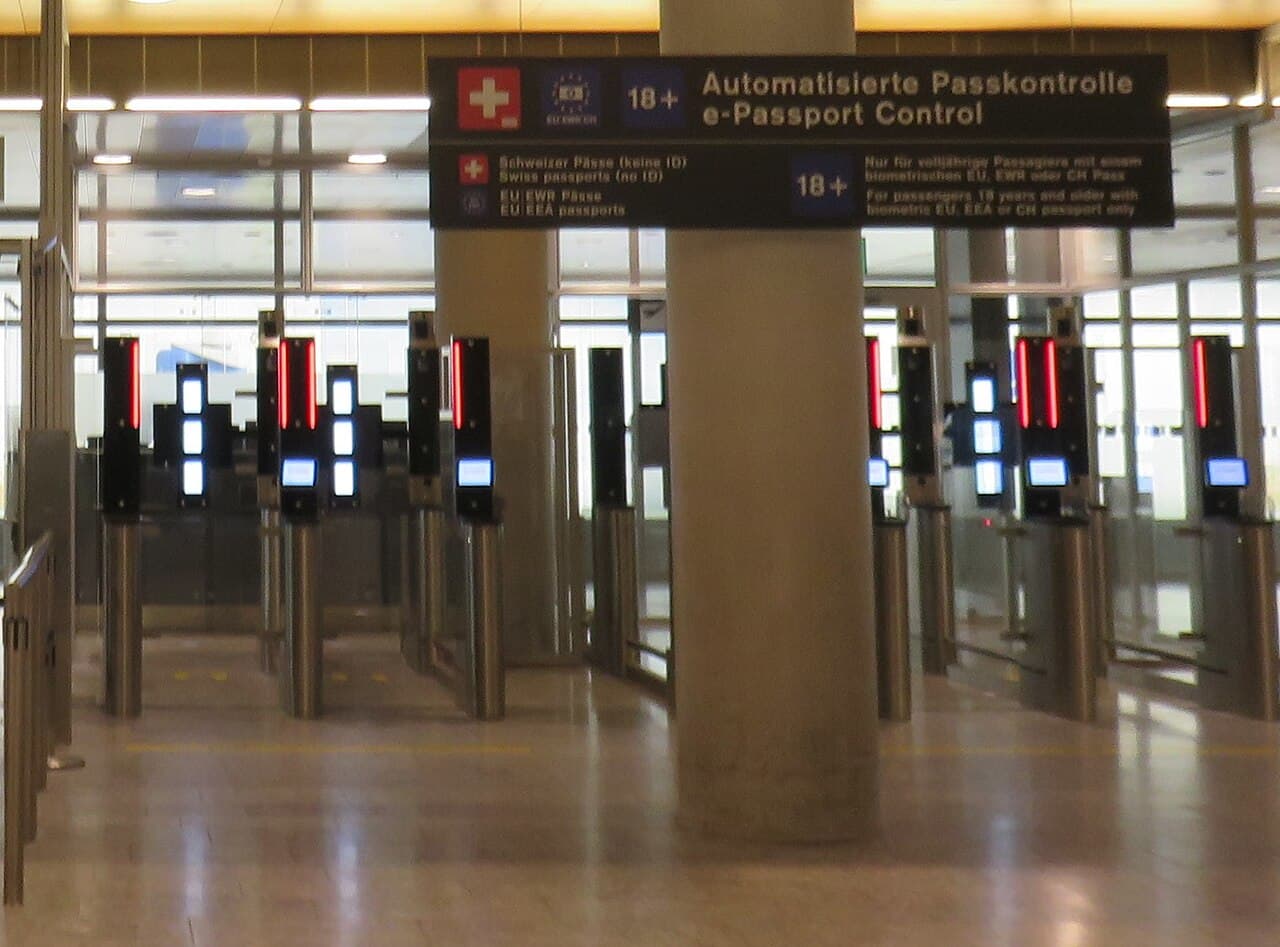
An eGate is a self-service barrier that reads your passport chip and uses a camera to compare your face with the photo stored on the chip. If the data matches, the gate opens and you cross the border without an officer.
The whole process takes 15-30 seconds — several times faster than queuing for a live officer. That saves real time at peak hours, especially at large hubs where minimum connection time matters.
Who can use eGates
Here's the key detail: eGates are mostly open to citizens of specific countries. At EU airports they're used by EU/EEA and Swiss citizens; in the UK, by British nationals plus a handful of selected countries (USA, Canada, Australia, Japan and others).
A Georgian citizen usually still has to go to a live officer (the "All passports" or "Non-EU" lane), because on first entry the border service collects biometric data. That step is described in detail in Airport arrival: passport control and baggage.
A biometric passport (with a chip) is required for eGates, but it isn't enough on its own — your nationality also has to be on a given airport's eligible list.
EES and ETIAS — what changes in 2026
In 2026 the EU is gradually rolling out two new systems. EES (Entry/Exit System) is a digital border that records your fingerprints and face photo on entry and exit instead of stamping the passport. The first registration happens at a staffed point, after which some airports let you use eGates too.
ETIAS is a €7 online authorisation that visa-free travellers — including Georgians — will need before flying. It isn't a visa, but without it you won't be allowed to board. Full details in ETIAS 2026 and the Schengen 90/180 rule.
ETIAS and EES don't replace each other — ETIAS is the advance permission, while EES is the digital record of the border crossing itself. In 2026 you'll need to account for both.
Where you'll find eGates
Always check the rules of the specific airport — eGates often work only on arrival or only on departure.
- Major European hubs — Amsterdam Schiphol, Paris CDG, Frankfurt, Madrid
- United Kingdom — Heathrow, Gatwick, Manchester (with an eligible-country list)
- Istanbul (IST) — automated gates for e-gate card holders
- Dubai (DXB) — Smart Gates and facial-recognition lanes
Practical tips
- Carry a biometric passport and check its validity rules
- Remove glasses, hat and mask at the eGate — they block facial recognition
- Children under 12-18 often can't use eGates — go to a live officer as a family
- If the gate doesn't open, don't worry — an officer beside it will process you manually
- Plan your flight and return dates with the Travel365 price calendar
In transit you often don't need passport control at all — check whether your connection stays in one terminal or requires crossing the border. See Layovers and transit.
Tags