Traveling Europe by ferry is an experience in its own right — from the Greek islands to Croatia's Adriatic and the Baltic Sea, the ferry is often the only, or the most beautiful, way to reach your destination. This guide explains where and how to travel by ferry, where to buy tickets, what it costs and how to avoid common mistakes.
⛴️ Europe's main ferry routes
The ferry is a full part of the transport network in many parts of Europe, not just a tourist attraction. It links islands, cities and sometimes countries.
- The Greek islands — from Piraeus to Santorini, Mykonos, Crete and thousands of other islands
- Croatia's Adriatic — from Split and Dubrovnik to Hvar, Korčula and other islands
- Italy — from Naples to Capri, and Sicily and Sardinia
- The Baltic Sea — Helsinki-Tallinn, Stockholm-Tallinn, by overnight ferry
- Spain — from Barcelona and Valencia to the Balearic Islands (Mallorca, Ibiza)
🎫 Where and how to buy tickets
A ferry ticket is bought online or at the port. In summer, at peak season, buy tickets in advance on popular routes — especially if you're taking a car. Online platforms (Ferryhopper, Direct Ferries) compare companies and schedules in one place.
On short, frequent routes (e.g. between islands) you can often buy at the dock, but in season that's a risk. The price depends on the distance, the speed (fast ferry vs regular) and the class.
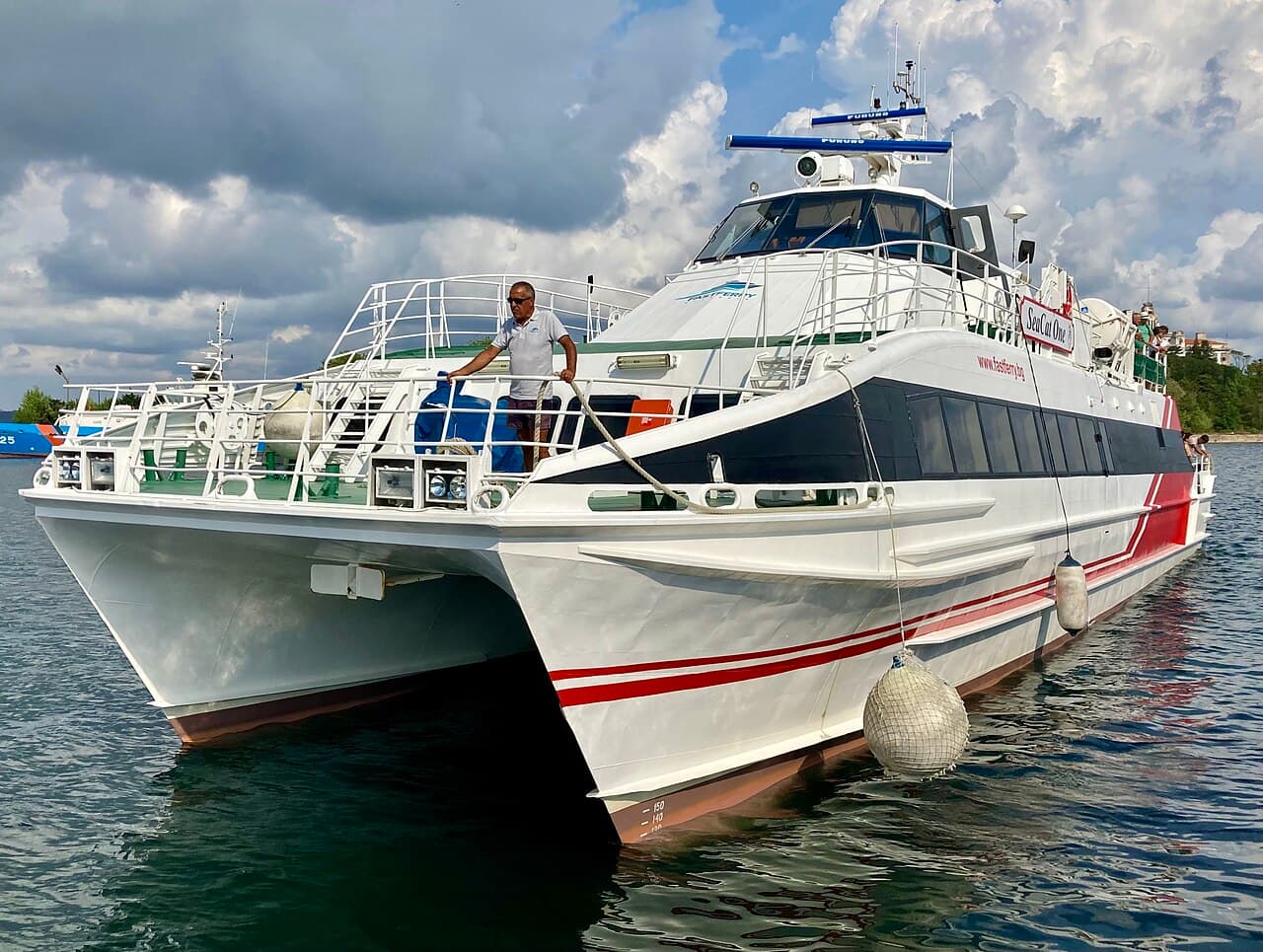
A fast ferry (catamaran) is twice as fast as a regular one, but pricier and more sensitive to the weather. In rough seas fast crossings are often cancelled — leave a buffer day.
💶 Prices and classes
A ferry ticket's price varies widely. A short inter-island hop costs $6-15, while a long or overnight route runs $30-100 — cabin included. On an overnight ferry a cabin also saves you a hotel.
- Deck/economy seat — the cheapest, comfortable on short day crossings
- Cabin — on long overnight routes, you sleep like in a hotel along the way
- Car/bicycle — a separate fare, booking ahead is essential in season
- Children and students often get a discount
🧭 Practical tips
Arrive at the port on time — ferry boarding often begins 30-60 minutes before departure, and earlier with a car. Carry your passport, your ticket (often on your phone is enough) and a little cash for small port expenses.
Ferry travel pairs naturally with land transport — see Europe public transport and night trains in Europe. For coastal destinations, Europe's best beaches will help.
If you're prone to seasickness, take medication in advance and pick a seat in the middle of the ferry, low down — that's where the motion is least.
💡 Summary
- At peak season buy tickets in advance, especially with a car
- A fast ferry is pricier and weather-sensitive — leave a buffer day
- On an overnight ferry a cabin saves you a hotel cost
- Arrive at the port early and carry your passport
- Pair the ferry route with a flight — find a cheap flight to a city near the islands on the Travel365 price calendar, e.g. Athens or Split
Tags