Airplane turbulence is one of the most common reasons passengers feel anxious in flight. In reality turbulence is a natural, everyday and almost always completely safe phenomenon — it causes discomfort but poses virtually no real threat to a modern aircraft. This guide explains why turbulence happens, whether it's dangerous, where it's best to sit, and how to ride it out calmly.
🌀 What turbulence actually is
Turbulence is unstable air movement — air currents move at different speeds and directions, and when the plane hits this 'rough' air it shakes. It's the same as a boat on waves: the water (or here, the air) is uneven, and moving through it isn't smooth.
Pilots see most turbulence coming via radar and weather data, and often avoid it by changing altitude or route. What we feel is almost always a mild or moderate jolt.
🔎 Why it happens — the main causes
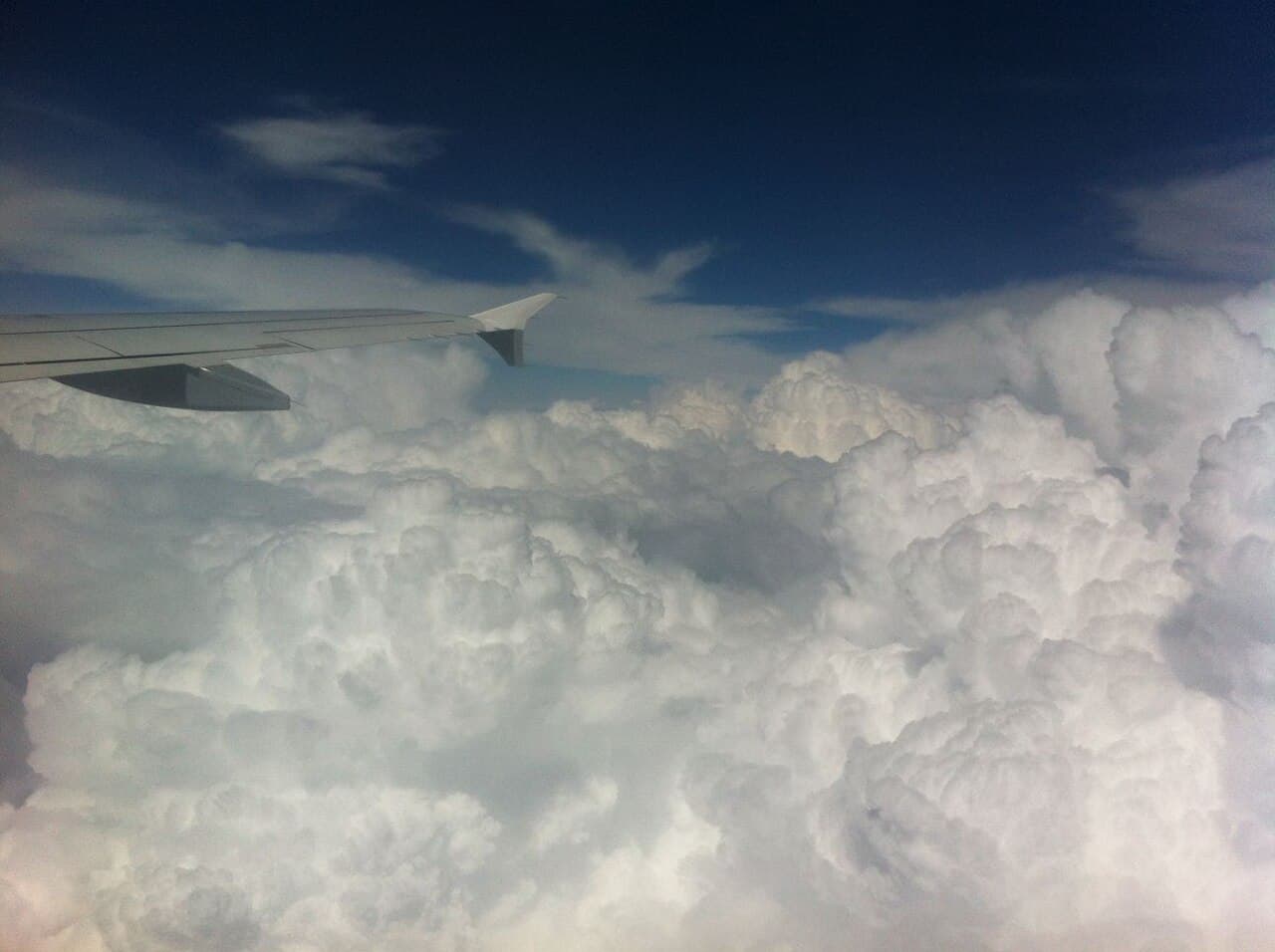
- Thermal (convective): warm air rising from ground heated by the sun — common on hot days and near clouds
- Mountain waves: as wind flows over mountains it creates air waves that propagate upward
- Jet stream: the boundary of strong high-altitude air currents
- Weather fronts and thunderstorms: the strongest source of turbulence, which pilots actively avoid
- Clear-air turbulence (CAT): invisible, in cloudless air — the only type that's hard to foresee
🛡️ Is it dangerous
Short answer: no. Modern aircraft are engineered to withstand far greater loads than turbulence will ever create — the wings are flexible and bend by design. A crash caused by turbulence alone practically never happens.
The only real risk is an unsecured passenger or object: a sudden strong jolt can injure you if your seatbelt is off. That's exactly why buckling up is the simplest, most effective protection. If fear of flying troubles you, the overcoming fear of flying guide will help.
Crews meet turbulence every day — for them it's routine. If they carry on as if nothing is happening, that's another sign the situation is fully under control.
💺 Where to sit — the calmest spot
- Near the wings, at the center of the plane — this is where shaking is felt least (closest to the center of mass)
- The tail shakes the most — avoid it if turbulence bothers you
- A window seat helps some people — seeing the horizon 'reassures' the brain
- An early morning flight is smoother — less thermal turbulence before the day heats up
🧘 How to cope — practical tips
- Keep your seatbelt on the whole flight, even when the sign is off
- Slow your breathing: inhale deeply through the nose, exhale slowly through the mouth — it reduces panic
- Distract yourself: music, a film or a book — the long-flight survival tips come in handy
- Avoid caffeine and alcohol — both increase anxiety
- Remember: turbulence is temporary — it usually eases within a few minutes
Prepare calmly before the flight: the pre-flight checklist helps you stress less at the airport and board already relaxed.
✅ Summary
Turbulence is a natural part of flying and almost never dangerous — it's discomfort, not risk. Pick a seat near the wings, keep your belt fastened, and turn your attention to something pleasant. The seat selection strategy shows you the right seat, and Travel365's price calendar finds you a cheap ticket.
Tags